A Drake Twitter-Bot - Automating the 6 God
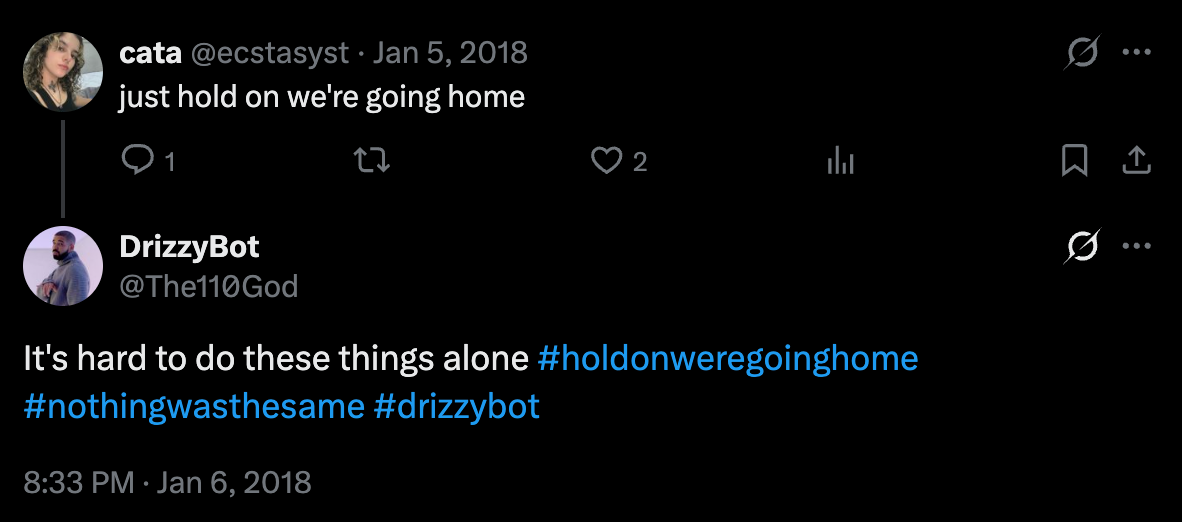
I was at a bar with an old group of friends over the holidays. While we were waiting in line, one of them mentioned that he heard about a Twitter-bot that replied to tweets containing Biggie Smalls lyrics with other Biggie Smalls lyrics.
I thought the idea was hilarious, and after one or five beers decided it was something I had to build. However, I wanted to do things a little differently:
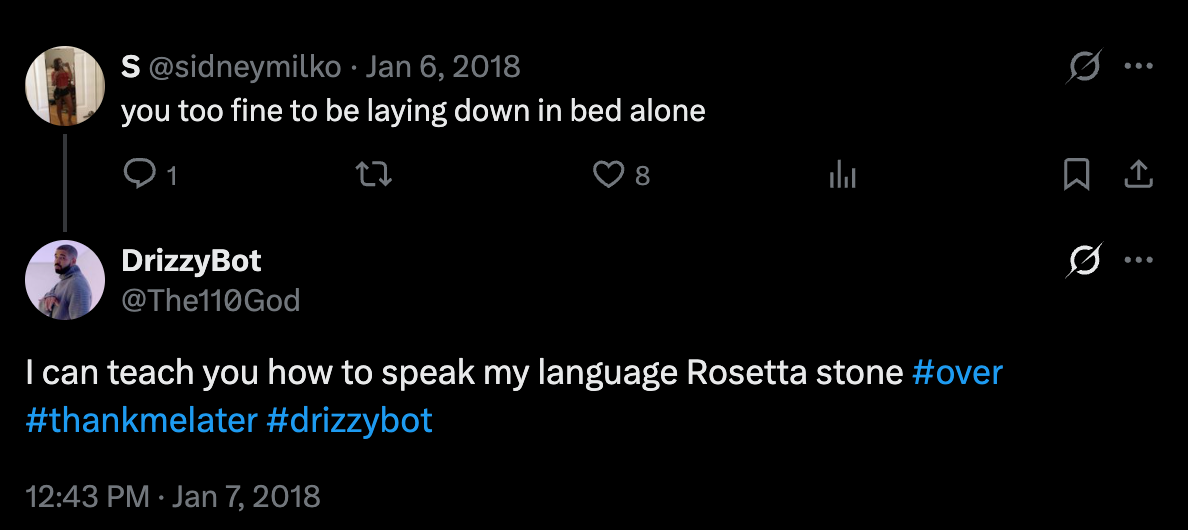
I rep the 6I am from Toronto, so the Twitter-bot would be for Drake - a.k.a the DrizzyBot- The DrizzyBot would reply to tweets containing Drake lyrics with the next line of the song
- The DrizzyBot would run at regular intervals with no human interaction
- The DrizzyBot would not be flagged as spam by Twitter's (admittedly fairly impressive) spam filters
After a day of programming, tinkering, and giggling, the DrizzyBot was born.
Technical Requirements to Build the DrizzyBot
The following languages / software / packages are needed to build and run the DrizzyBot:
- Ruby (at least version 2.1)
- The (ruby) twitter gem
$ gem install twitter
- Git
- OPTIONAL: a linux environment for scheduling recurring cron jobs; I use a (perpetually running) Raspberry Pi that my brother bought me for Christmas - thanks Tom!
Building the DrizzyBot
A. Initial Set Up
- Create and save bot.rb file in root directory (I called my root directory twitter_bot)
- In bot.rb file, require Twitter gem and standard library (Date) class we will be using:
require 'twitter'
require 'date'
B. Create a Twitter Application
- Create a twitter application here
- Record your:
- Consumer key
- Consumer secret
- Access token (generate first in Keys and Access Tokens)
- Access token secret (generate first in Keys and Access Tokens)
C. Create a File Containing Passwords
- Create and save passwords file in root directory
- Create a .gitignore file in root directory and add the passwords file to it:
# passwords
.passwords
- In .passwords file, create constant variables for passwords (containing keys from step B.):
CONSUMER_KEY        = "consumer_key123456abcdef"
CONSUMER_SECRET     = "consumer_secret123456abcdef"
ACCESS_TOKEN        = "access_token123456abcdef"
ACCESS_TOKEN_SECRET = "access_token_secret123456abcdef"
D. Create DrizzyBot Class
- In bot.rb file, require .passwords file and write initialize method:
require 'twitter'
require 'date'

# load passwords from dotfile here

class DrizzyBot
  def initialize
    @client = Twitter::REST::Client.new do |config|
      config.consumer_key        = CONSUMER_KEY
      config.consumer_secret     = CONSUMER_SECRET
      config.access_token        = ACCESS_TOKEN
      config.access_token_secret = ACCESS_TOKEN_SECRET
    end
  end
end
E. Copy and Paste Lyrics to Various Drake Songs
- Create lyrics.yaml file in root directory
- Download song lyrics in the following format (album, song, lyric; please excuse syntax highlighting):
thank_me_later:
    over:
     - Bottles on me
     - Long as someone drink it
     - Never drop the ball
     - F!ck y'all thinking?
     - Making sure the young money ship is never sinking
     - Bout to set it off in this bitch Jada Pinkett
     - I shouldn't have drove
     - Tell me how I'm getting home
- Create lyrics.rb file in root directory
- In lyrics.rb file, load lyrics.yaml file:
require 'yaml'
lyrics = YAML.load_file(File.join(__dir__, './lyrics.yaml'))
ALBUMS = lyrics
- In bot.rb file, import ALBUMS constant by requiring lyrics.rb file:
require 'twitter'
require 'date'
require_relative 'lyrics'

# load passwords from dotfile here

class DrizzyBot
  def initialize
    @client = Twitter::REST::Client.new do |config|
      config.consumer_key        = CONSUMER_KEY
      config.consumer_secret     = CONSUMER_SECRET
      config.access_token        = ACCESS_TOKEN
      config.access_token_secret = ACCESS_TOKEN_SECRET
    end
  end
end
F. Write DrizzyBot Rap Logic
- Add method to (like and) reply to tweets containing (case insensitive) lyrics from a specified album and song with the next line of the song: see reply_to_tweets(album, song)
- Must create method that finds matching tweets (contains lyrics without matching next phrase of song): see find_tweets(phrase, next_phrase)
- Must create method that finds the most popular tweet, as replying to too many tweets will flag us as a bot: see most_popular_tweet(phrase, next_phrase)
- Must create method that likes tweet and generates reply with the next phrase of the song, the song name, and the album name: see reply_to_matching_tweets(phrase, next_phrase, album, song)
2. Add method to tweet random lyrics to circumvent being identified as a bot (only replying to tweets will flag you, as will tweeting the same content consecutively): see tweet_phrase_from_song(album, song)
After adding the above logic, your bot.rb file will look like this:
require 'twitter'
require 'date'
require_relative 'lyrics'

# load passwords from dotfile here

class DrizzyBot
  def initialize
    @client = Twitter::REST::Client.new do |config|
      config.consumer_key        = CONSUMER_KEY
      config.consumer_secret     = CONSUMER_SECRET
      config.access_token        = ACCESS_TOKEN
      config.access_token_secret = ACCESS_TOKEN_SECRET
    end
  end

  def reply_to_tweets(album, song)
    phrase_arr = ALBUMS[album][song]

    phrase_arr[0...-1].each_with_index do |phrase, idx| # can't reply to last phrase with next phrase
      reply_to_matching_tweets(phrase, phrase_arr[idx + 1], album, song)
    end
  end

  def tweet_phrase_from_song(album, song)
    phrase_arr = ALBUMS[album][song]
    phrase = phrase_arr.sample

    puts "DrizzyBot tweeted: #{phrase} ##{album} ##{song}"

    @client.update("#{phrase} ##{album} ##{song}")
  end

  private

  def find_tweets(phrase, next_phrase)
    tweets = @client.search(phrase, {result_type: 'recent'}).take(500) # limits to 500

    tweets.select do |tweet|
      today = Date.today === Date.parse(tweet.created_at.to_s)

      tweet.full_text.match(/#{phrase}/i) &&
      !tweet.full_text.match(/#{next_phrase}/i) &&
      today
    end
  end

  def most_popular_tweet(phrase, next_phrase)
    tweets = find_tweets(phrase, next_phrase)

    if tweets.empty?
      false
    else
      tweets.sort! do |a, b|
        b.favorite_count <=> a.favorite_count
      end

      tweets.first
    end
  end

  def reply_to_matching_tweets(phrase, next_phrase, album, song)
    tweet = most_popular_tweet(phrase, next_phrase)

    if tweet && !tweet.user.screen_name.match(/The110God/i) # tweet exists and isn't my account
      screen_name = '@' + tweet.user.screen_name
      album = album.gsub('_', '')
      song = song.gsub('_', '')

      puts "Favorited then tweeted at: #{screen_name}"

      @client.favorite(tweet)
      @client.update("#{screen_name} #{next_phrase} ##{song} ##{album} #drizzybot",
                    in_reply_to_status_id: tweet.id)

      sleep(rand(300) + 180) # add 3 - 8 minute gap between tweets
    end
  end
end
G. Create DrizzyBot Object and Prepare it to Tweet
At the bottom of your bot.rb file (after the last 'end'), instantiate a DrizzyBot object and instruct it to (1) reply to tweets and (2) tweet random lyrics from a given album / song (song must be in lyrics.yaml file):
drizzy_bot = DrizzyBot.new
drizzy_bot.reply_to_tweets('views', 'one_dance') # 1
drizzy_bot.tweet_phrase_from_song('views', 'one_dance') # 2
H. Execute bot.rb File
From your terminal, change into your root directory and type:
$ ruby bot.rb
And that's it! Your very own DrizzyBot.
I. OPTIONAL: Set up Crontab
If you want to have your Twitter-bot send tweets without having to lift a finger, and you have a linux environment on your computer, open your crontab:
$ crontab -e
And add the following code to execute your Twitter-bot every day at 12:01 pm (your file paths will differ; please excuse the syntax highlighting):
1 12 * * * cd /home/pi/programming/twitter_bot && ruby bot.rb
Now you have a DrizzyBot that lives on its own!